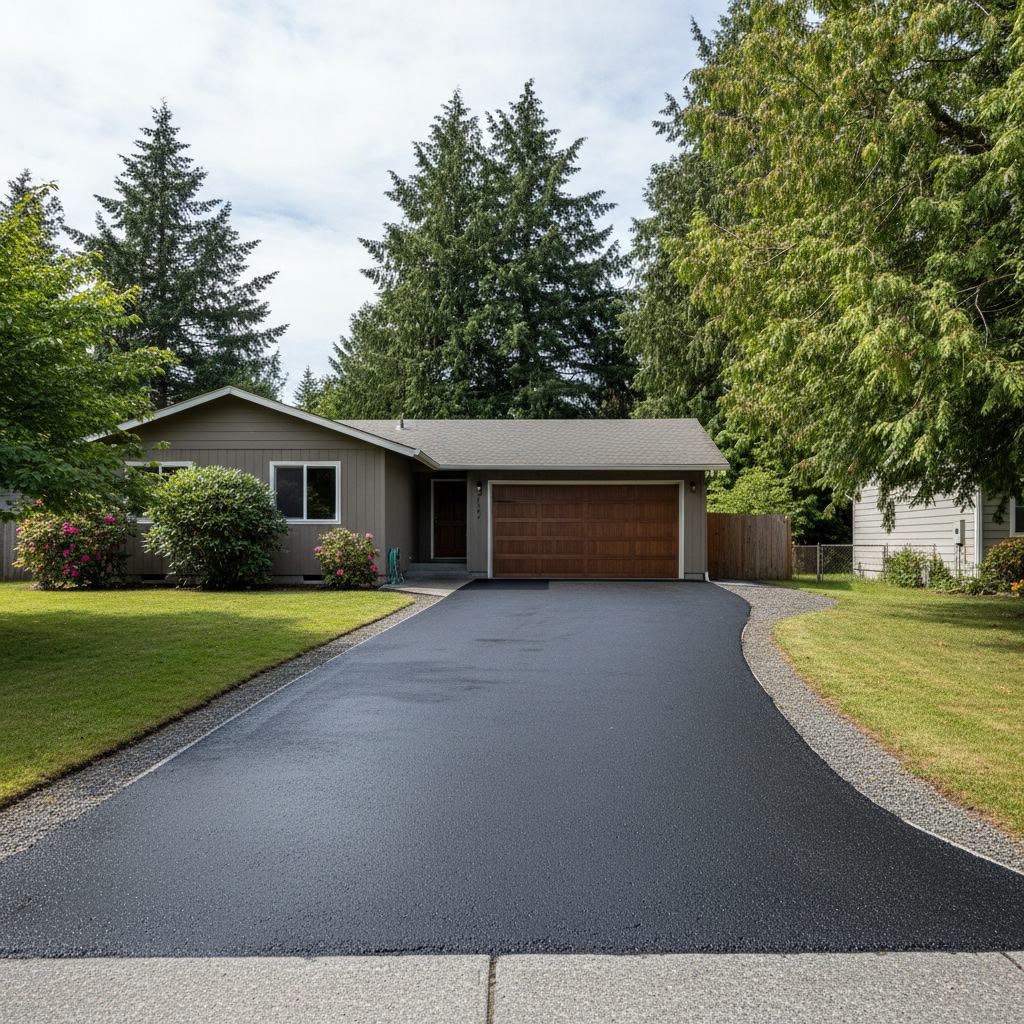
You're probably looking at your driveway, seeing it fade, maybe a few small cracks popping up, and thinking, "It's time for sealcoating." Good call. Sealcoating is one of the best things you can do to protect your asphalt, extending its life and keeping it looking sharp. But then the big question hits: what's it actually going to cost me?
I get this question all the time from folks right here in Arlington, from the older homes near the Stillaguamish River to the newer developments up by Smokey Point. It's not a simple one-size-fits-all answer, but I can give you a pretty solid idea of what to expect and what drives those numbers.
What Affects Sealcoating Pricing?
A few key things really push the price up or down. Understanding these will help you make sense of any quote you get.
- Size of the Area: This is the biggest one, obviously. A small 400 sq ft residential driveway is going to cost a lot less than a 10,000 sq ft commercial parking lot. Most contractors price by the square foot, but there's usually a minimum charge for smaller jobs because of the time it takes to mobilize crew and equipment.
- Condition of the Pavement: If your asphalt is riddled with cracks, potholes, or has significant oil stains, it's going to need more prep work. We can't just sealcoat over big problems; they need to be repaired first. Crack filling, patching, and cleaning all add labor and material costs. A well-maintained surface that just needs a refresh will be cheaper.
- Type of Sealant: There are different grades and types of sealants. Coal tar emulsion used to be common, but now asphalt emulsion and acrylic-based sealers are more prevalent, especially with environmental regulations. Higher-quality, longer-lasting sealants cost more upfront but often provide better protection and durability.
- Number of Coats: Most residential driveways get one good coat, maybe two if the asphalt is very old and porous. Commercial jobs often require two coats for maximum protection and a uniform finish, especially in high-traffic areas. More coats mean more material and labor.
- Accessibility and Layout: Is your driveway easy to access? Are there a lot of tight corners, intricate designs, or obstacles like landscaping islands that require more hand-work and precision? These can add to the labor time.
Typical Cost Ranges in Arlington, WA
Alright, let's get to some numbers. Keep in mind these are general ranges for Arlington and the surrounding areas. For a precise quote, you'll always need an on-site evaluation.
- Residential Driveways (Standard Condition): For a typical 400-800 square foot driveway in decent shape, you're usually looking at a range of $350 to $700. This often includes basic cleaning and one coat of quality sealant. If it's larger, say 1,000-1,500 sq ft, expect $600 to $1,200.
- Residential Driveways (Poor Condition): If your driveway needs significant crack filling (more than just a few hairline cracks) or minor patching, that cost can jump. Add $100 to $300+ for extensive crack filling, depending on the linear feet of cracks. Small patches might add $50-$150 each. So, a 1,000 sq ft driveway in rough shape could easily hit $1,000 to $1,500+.
- Commercial Parking Lots: For commercial properties, pricing is usually on a per-square-foot basis, and it tends to be lower per square foot than residential due to scale. For a 5,000 sq ft lot in good condition, you might see $0.20 to $0.40 per square foot, putting it in the $1,000 to $2,000 range for one coat. Larger lots (10,000 sq ft+) could be closer to $0.18 to $0.35 per square foot. This usually includes power blowing, sweeping, and two coats of sealant. If crack filling and line striping are needed, those are additional costs.
What Should Be Included in Your Quote?
When Coastal Asphalt Solutions gives you a quote, or any reputable contractor for that matter, it should be pretty clear about what you're getting. Here's what I always make sure to detail:
- Square Footage: The exact area being sealed.
- Prep Work: What kind of cleaning (power blowing, sweeping, oil spot priming) will be done. If crack filling or patching is needed, it should be itemized.
- Type of Sealant: The specific product being used.
- Number of Coats: Clearly stated.
- Application Method: Spray or squeegee. (Squeegee provides a thicker coat and better penetration, often preferred for rougher surfaces.)
- Curing Time: How long you'll need to stay off the pavement.
- Warranty: What kind of guarantee they offer.
Don't just get a number. Get a breakdown. It helps you compare apples to apples when you're looking at different bids.
How to Avoid Overpaying
Nobody wants to pay too much, especially for something that needs doing every few years. Here are my tips:
- Get Multiple Bids: Three quotes is usually a good number. Don't just go with the cheapest; compare what each contractor is offering for that price.
- Ask for Details: If a quote is vague, ask questions. What sealant are they using? How many coats? What prep work is included?
- Check References and Reviews: A good contractor will have a track record. Look for local reviews and ask for references.
- Beware of Door-to-Door Offers: If someone shows up unannounced offering a deal "because they just finished a job down the street," be very cautious. This is a common tactic for fly-by-night operations.
- Understand the Value: Sealcoating isn't just about making your driveway look good; it's about protecting a significant investment. Paying a little more for quality work and materials now can save you thousands in repairs or replacement down the road.
So, when you're ready to protect your asphalt, do your homework, ask the right questions, and you'll get a fair price for quality work. It's an investment that truly pays off.